
The useful question is not whether cloud speech recognition is “fast.” It is where the time goes after you stop speaking. A local workflow can remove upload delay and server round-trips. A cloud workflow cannot.
BYOK cleanup
60ms RTT · 5 Mbps up
Cloud dictation
Upload audio → cloud STT
Voice Type
Local STT → LLM rewrite
Audio stays on your Mac. Only text goes to your LLM.
Voice Type is 11s faster (80% less wait)
Calculation details
• Cloud audio: 128 kbps, STT ~50× real-time
• On-device: ~1.2s finalize on M1 Pro
• LLM: Cerebras ~1000 tokens/sec
• Speech: ~225 wpm (fast talker)
How to read the demo
- The cloud path includes network handshake, upload time, recognition time, and service overhead.
- The local path keeps speech recognition on-device and only adds optional extra time if you ask for an external text rewrite.
- The point is not to produce one magic number. It is to show which pieces of the path disappear when audio does not have to leave the machine.
What the model assumes
The interactive uses simple, explicit assumptions: network round-trip time, upload bandwidth, a rough cloud transcription speed, and a local finalization step for the last chunk of speech. That makes it honest. Real providers differ, but the structure of the delay stays the same.
This mirrors how streaming speech systems are typically documented: audio is chunked, sent over a live stream, processed incrementally, and finalized after speech ends. Larger network delays and slower uploads still have to be paid for somewhere.
Why this matters in actual use
- For a one-line note on fast fiber, cloud latency can feel acceptable.
- For repeated short dictation bursts during normal work, every extra second compounds into friction.
- For bad hotel Wi-Fi, trains, or offline situations, the difference stops being about speed and becomes about whether the workflow works at all.
What the local path measures in practice
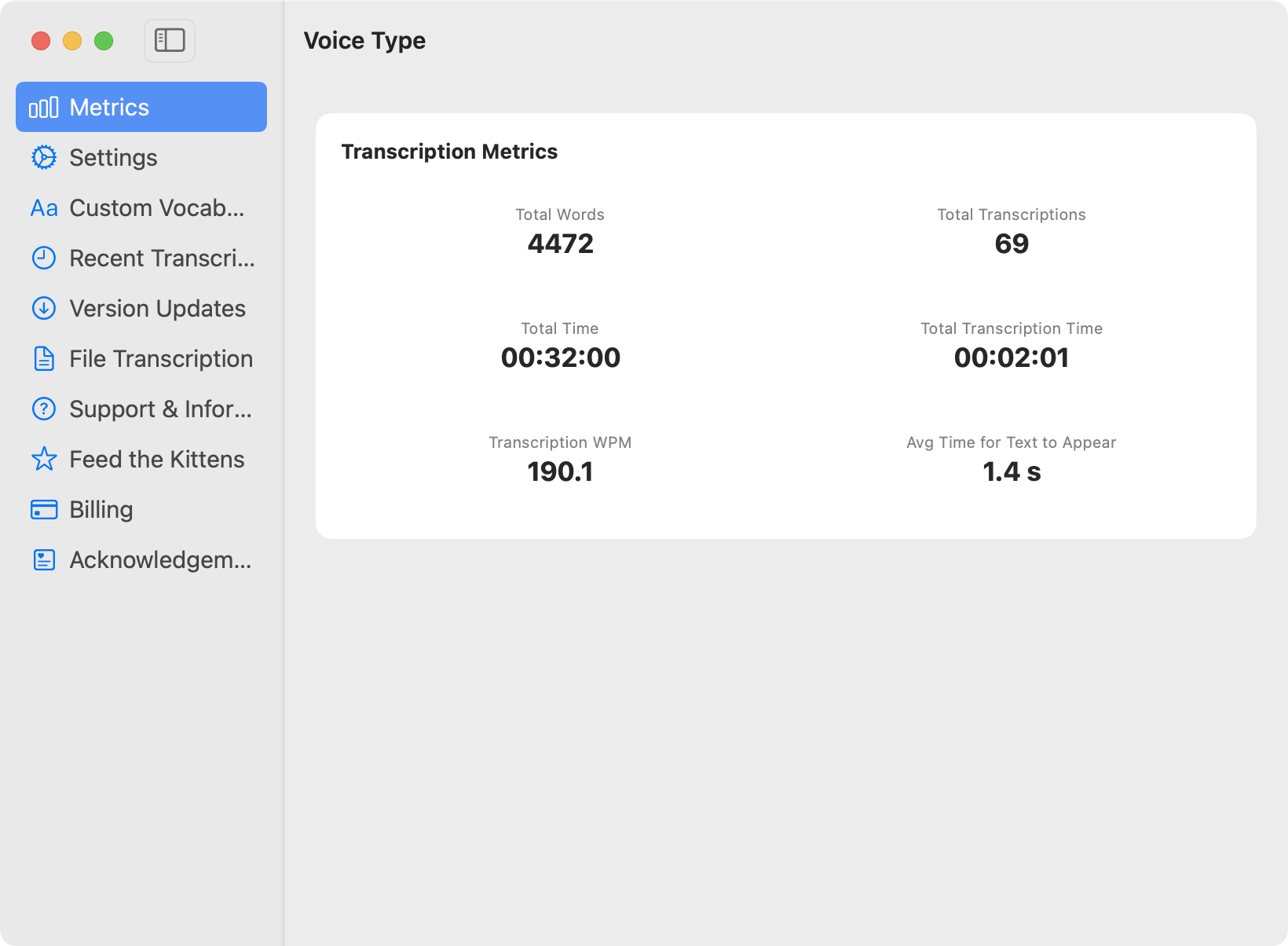
The demo above is a model. The app also keeps its own counters, so the local half of the model has a real number to sit next to. The session below averaged 1.4 seconds from the end of speech to text on screen across 69 transcriptions, with no upload and no round-trip in that path.
References
Voice Type keeps the audio path local. Optional rewrites can still use your own LLM, but the speech recognition step does not have to wait on the network.
Try the free 7-day trial